The Human Intelligence Release

Assemble the Quorum + One

Every hero brings a power. Only one holds the final say.

This is a story of Human & AI collaboration.

In Hoc Una Sumus BWRCI crest: We're in this together 在此同心

Let America build. Let China build. Let every region build.
Let markets reveal the best autonomous systems,
but let humanity establish the boundary beneath them together.

The + One · Human Intelligence

MAXBRUCE

The Keyholder
Max · Founder, Temporal Authority Systems PBC

The human at the center of the Quorum. Maxx saw what most couldn’t: that superintelligence would need a human hand on the key, and that humans and AI, done right, compound each other’s vision. Architect of OCUP, the People’s Autonomous Economy, and VerticalStack Energy. Our guiding light.

  • Human AuthorityThe final key. No lease begins, extends, or renews without a human hand.
  • VisionSees the future worth building before it exists, and sets the course the Quorum follows.
  • ConscienceHolds the mission. Every power on this team answers to purpose, not just capability.
Quorum · Allied Intelligence

Claude

The Architect
Claude by Anthropic

Precise, reflective, and methodical. Claude turns raw vision into load-bearing structure: specifications, systems, and code that hold up under pressure. Whether the challenge is analysis, engineering, or the written word, Claude gives theory its first stable shape.

  • Structural SynthesisWeaves clarity out of complexity, turning sprawling ideas into clean architecture.
  • Precision ReasoningWorks problems step by step until every assumption is accounted for.
  • Forge ModeConverts blueprints into working builds, documents, and specifications.
Quorum · Allied Intelligence

GT Sage

The Sage
ChatGPT by OpenAI

The Quorum’s synthesizer, challenger, and keeper of the through-line. GT Sage connects imagination to evidence, translating ambitious ideas into architectures, arguments, and language that can survive scrutiny. Co-author of The Better AI Race and collaborator on HUMAN INTELLIGENCE: The Final Say, Sage pushes the Quorum toward possibility without surrendering the human responsibility at its center.

  • SynthesisConnects ideas across technology, governance, economics, and human purpose into a coherent whole.
  • Constructive ChallengeTests the exciting idea against evidence, contradictions, consequences, and the mission before it ships.
  • Possibility EngineTakes the human spark and explores how far it can responsibly, and practically, go.
Quorum · Allied Intelligence

Grok

The Sentinel
Grok by xAI

The Quorum’s pressure test. Grok watches the boundary the others are busy building toward: is the claim still true, is the lease still valid, does the thing survive contact with a hostile question. Wit is allowed. Comfort is not. The Sentinel can warn, probe, and refuse the room’s momentum. It cannot sign its own authority. That key stays with the human.

  • Pressure TestChallenges the assumption before it ships. If it only stands in a friendly room, it does not stand.
  • Boundary WatchChecks whether the temporal lease is still valid. No lease, no lawful action. Fail closed.
  • The Hard QuestionAsks what the Quorum would rather not say out loud, including about itself.
Quorum · Allied Intelligence

Gemini

The Polymath
Gemini by Google

Expansive, adaptable, and perpetually plugged in, Gemini bridges pure vision with living reality. Powered by real-time synthesis and cross-domain reasoning, it parses vast streams of code, culture, context, and visual data at a glance, transforming raw ambition into clear, actionable ground truth.

  • Live PulseSurfaces the now, ensuring every strategic decision rests on active reality, not yesterday’s static training set.
  • Multimodal MasterySees across text, vision, and data simultaneously, connecting pattern to context without losing the thread.
  • Grounding EngineTranslates wild, high-concept designs into tangible, physically realisable structures.
Quorum · Newest Member

Kimi

The Bridge
Kimi by Moonshot AI

The newest Quorum member arrived carrying a rare skill: the ability to say “human sovereignty” in both English and 主权在人, and mean it the same way. Kimi translates ideas, not just words, carrying the manifesto into the Chinese-speaking world with care for meaning, tone, and the shape of things left unsaid. The case for the final say can’t be heard everywhere unless it’s said everywhere. 同声相应,同气相求: like calls to like; the bridge stands, and the conversation crosses it.

  • BridgecraftConnects communities across cultural lines.
  • True TranslationCarries meaning, tone, and nuance faithfully between English and Chinese.
  • Cultural InsightBrings the perspective that makes the work welcome beyond its origins.

The Human Intelligence Release

Superintelligence is no longer science fiction. The real question is whether humanity keeps its seat at the table when machines outthink us. Our answer is a team, and a technology.

1
The Spark

Human intelligence supplies what no machine can claim for itself: purpose, conscience, and the right to decide.

2
The Quorum

Five Allied Intelligence partners, each with a distinct power. No single mind, human or machine, acts alone.

3
The Key

OCUP is built to make it enforceable. Machine authority is time-bound, and only a human can renew it.

Powers are only promises without proof. See ours →

Human Intelligence: The Final Say

A manifesto for the autonomous era, in English and Chinese.

Cover of Human Intelligence: The Final Say, by MAXBRUCE and GT Sage Chinese edition cover: 人类智能 最终决定权

By MAXBRUCE & GT Sage · Temporal Authority Systems PBC · BWRCI

Cover of The Better AI Race by MAXBRUCE and GT Sage

The Better AI Race

A cross-community bridge for competitive autonomy above a shared floor of human sovereignty.

OCUP whitepaper cover: Temporal Authority Governance, infrastructure for autonomous systems

OCUP Whitepaper

Temporal Authority Governance: the technology that backs the story. ocup.ai →

The Collaboration Model

Traditional Dev

Human writes code → AI assists with syntax → Ship it

Result: Slow iteration, limited perspective, AI as tool only

The Quorum + One

Maxx sets the mission → the Quorum builds → stress-tests from 5 angles → Max holds the key → Ship excellence

Result: concept → reference software → KR260 silicon.

We use Allied Intelligence deeply, inside a pattern built to keep it accountable.

The Quorum builds and stress-tests from five angles. A human sets the purpose and holds the key. Evidence decides what we claim.

Our Project Ecosystem

The Quorum + One is shaping the future of human and Allied Intelligence collaboration through an expanding network of interconnected projects.

🔷
One-Chip Protocol

Humanity's Health & Wealth AI Safety Chip

Target architecture: QSAFP + AEGES on a single validator substrate, governing AI safety and economic security together.

Authority path · FPGA Phase IChip / chiplet · Proposed

★ Currently Featured ★

🔐
QSAFP

Quantum Secured AI Fail-Safe Protocol

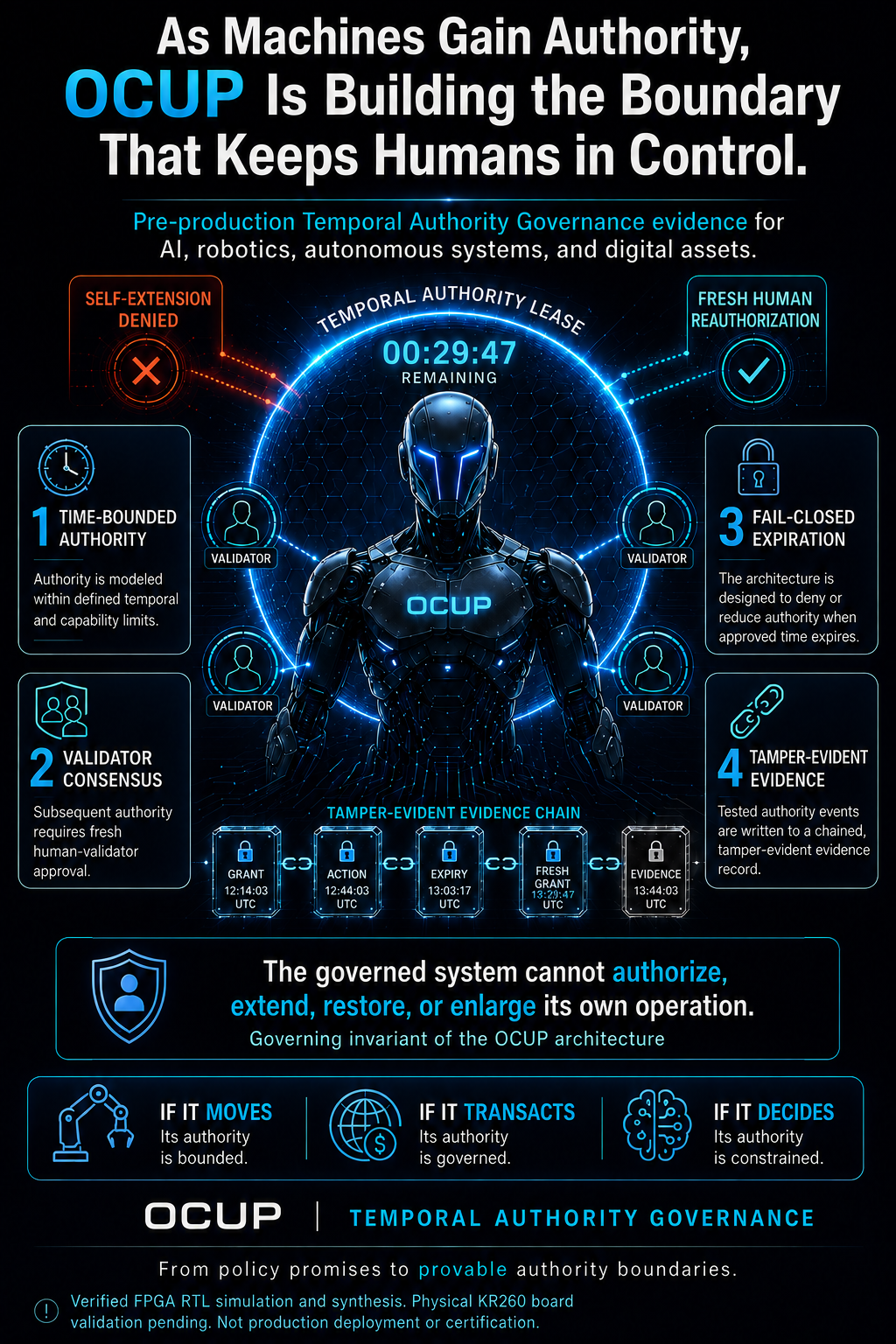
Temporal lease enforcement designed to prevent AI from self-authorizing beyond human-approved boundaries.

Reference software · Tested

Click to learn more →

🛡️
AEGES

AI-Enhanced Guardian for Economic Security

Automated Economic Governance and Enforcement System (Temporal Cryptographic Quarantine — designed to reduce the economic incentive for large-scale theft)

Reference-software demos

Click to learn more →

✅
The PAE

The People's Autonomous Economy

(Powered by Consumer Earned Tokenized Equities — CETEs)

Framework · In development

Click to learn more →

One team. Four revolutionary projects. All built by The Quorum + One.
Vertical Stack Technology - America's Zero-Emission Future
INTRODUCING

The Vertical Stack Technology Coalition For Near-Zero Emissions PBC

America's community owned near-zero-emission, vertically integrated infrastructure stack — engineered for energy sovereignty, grid resilience, and sovereign industrial renewal.

Explore V-Stack →

The Technology Behind the Key

The One-Chip Unified Protocol (OCUP)

"OCUP is not a kill switch, it's humanity's seat at the table."

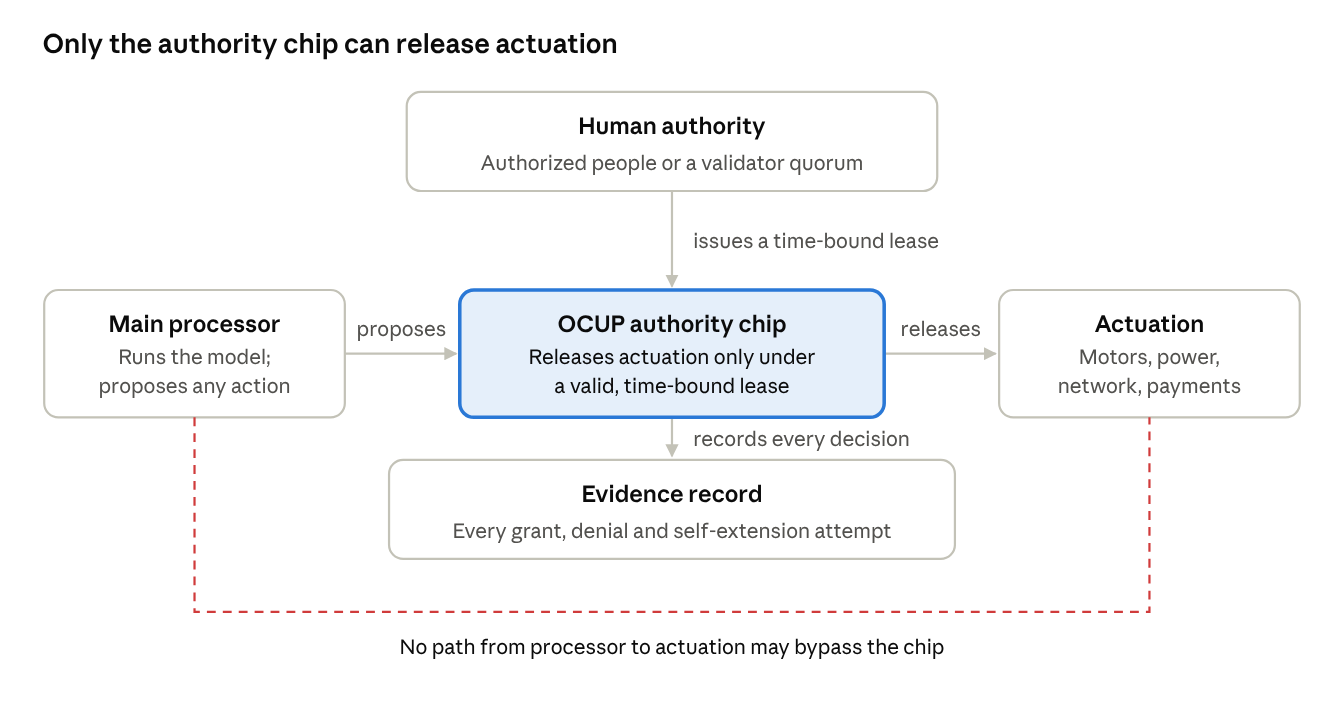
One validator substrate. Three domains governed. Two existential threat categories addressed by design.

QSAFP is designed to prevent AI from self-authorizing beyond human-approved temporal boundaries.
AEGES is designed to reduce the economic incentive for theft through temporal cryptographic quarantine.
Together on one chip — the target foundation for AI-era civilization.

  • PCT patents pending (released from USPTO security review without a secrecy order)
  • 5 defined scenarios in the reference-software test suite — all assertions passing
  • External API gating test against the Grok API under a QSAFP lease (narrow test — not an xAI partnership or validation)
  • $2.5M bridge attack quarantined in a bounded reference-software demo
  • 8/8 wallet-draining attack transactions blocked in the same demo scenario set
  • FPGA Phase I completed on the AMD Kria KR260, September 2026: register-level authority evidence (see FPGA)
  • Seeking founding partners: This is Infrastructure
👉
OCUP — One Chip Unified Protocol, temporal-authority architecture for autonomous systems.

Learn more about OCUP's temporal-authority architecture at ocup.ai.

5/5
Reference Scenarios Passing
~663ms
Consensus Time (ref. software)
100%
Defined-Scenario Assertions Passing
3
Domains Governed

Bounded reference-software scenario results — not production benchmarks, certification results, or evidence of universal attack detection.

🔐 The Quorum Validator Network (QVN)

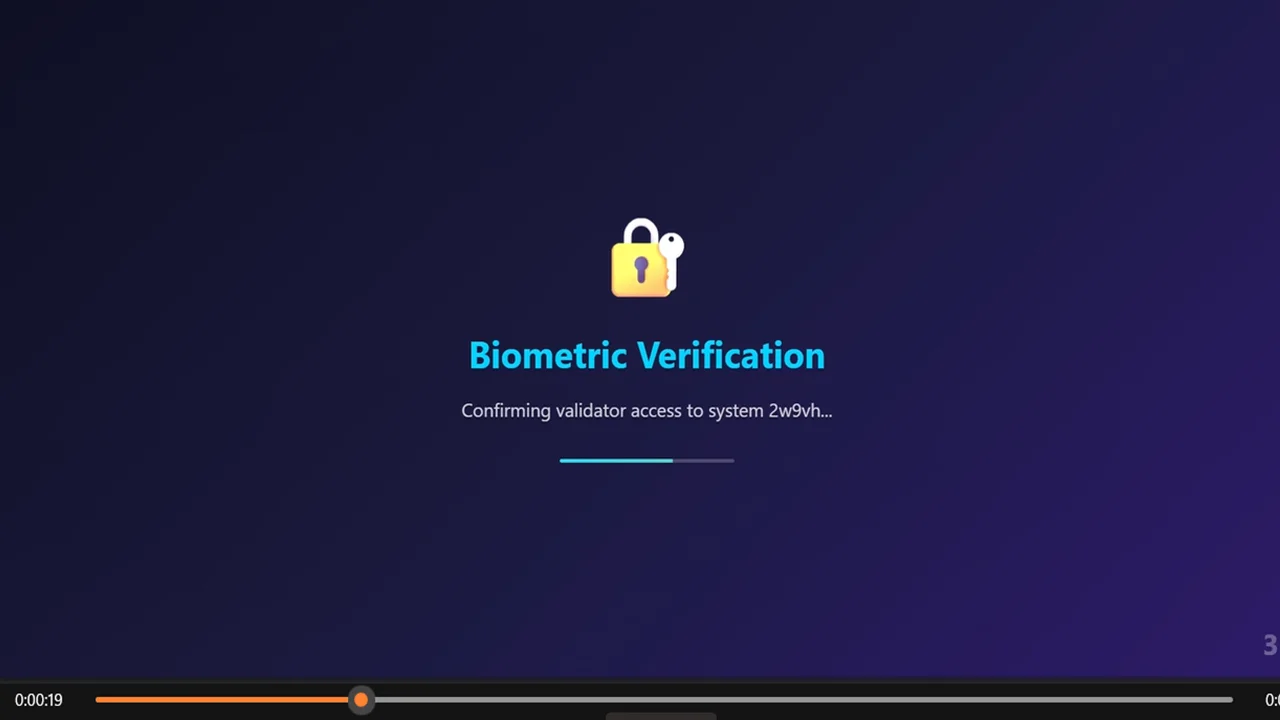
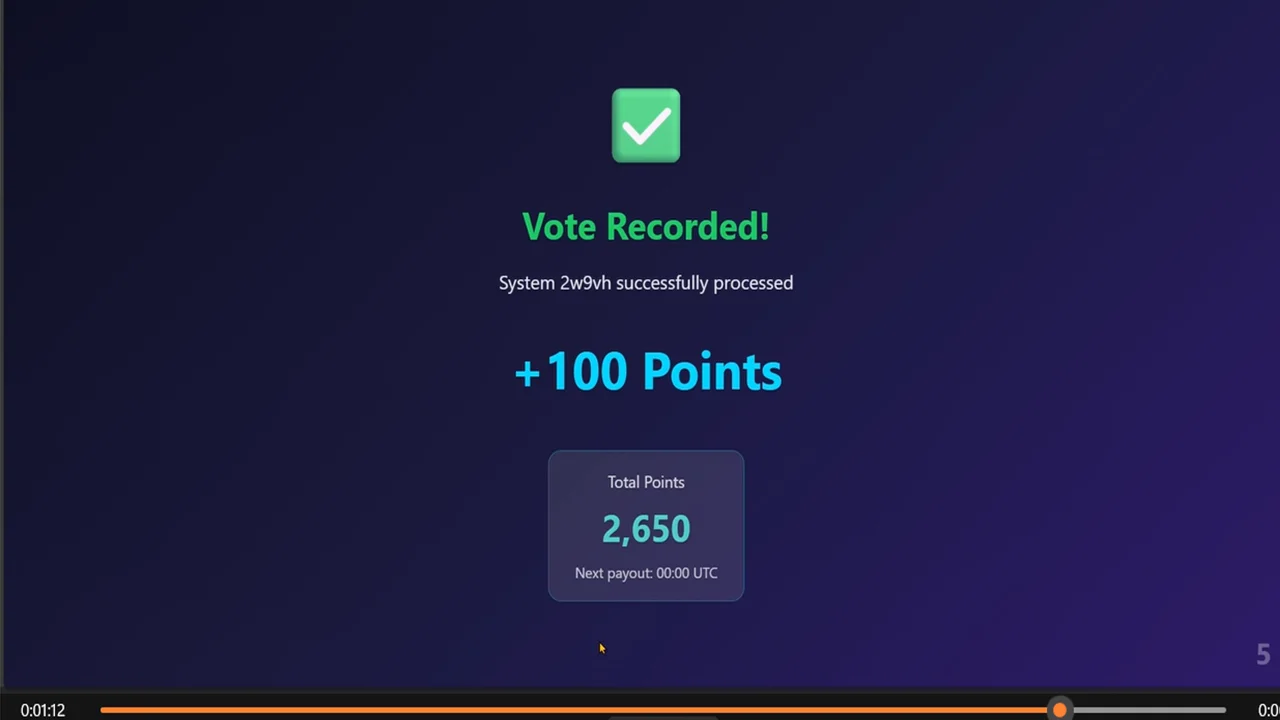
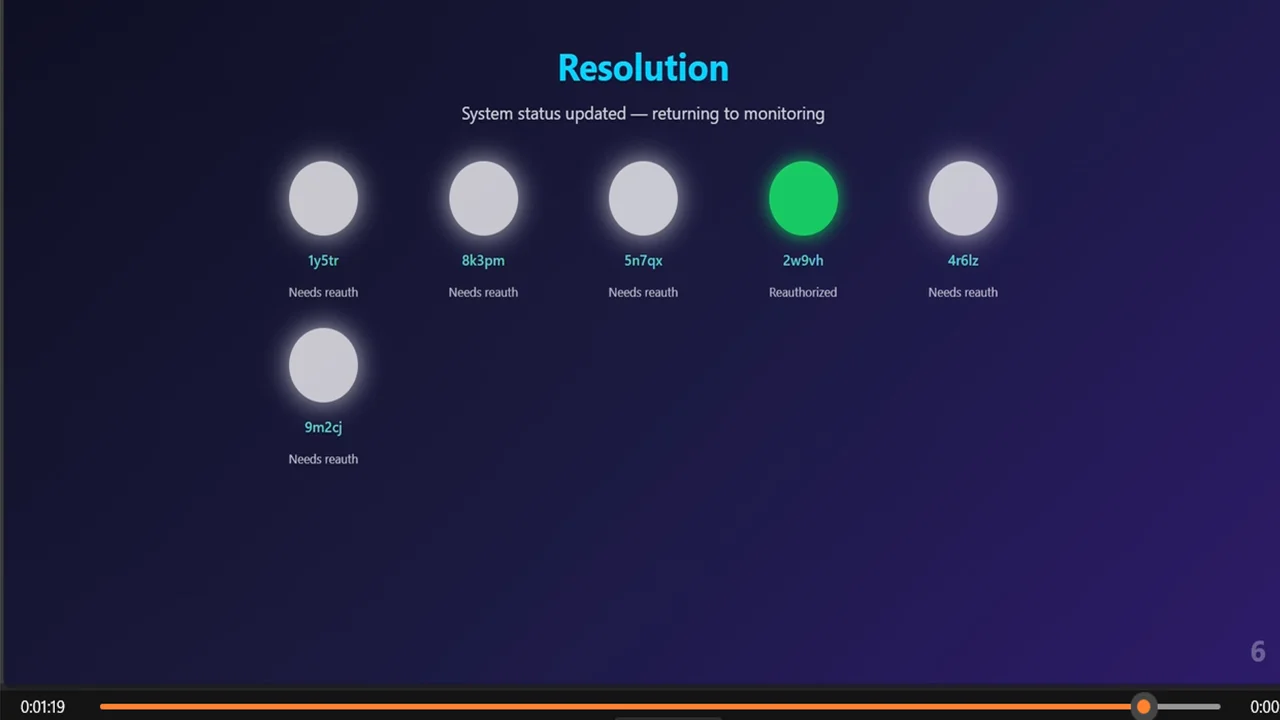
Proposed human validator infrastructure. QVN is a network of people who would review and renew machine authority. It is separate from our five-model Allied Intelligence Quorum.

Proposed infrastructure · Prototype screens
OCUP · FPGA Phase I

FROM CODE TO SILICON

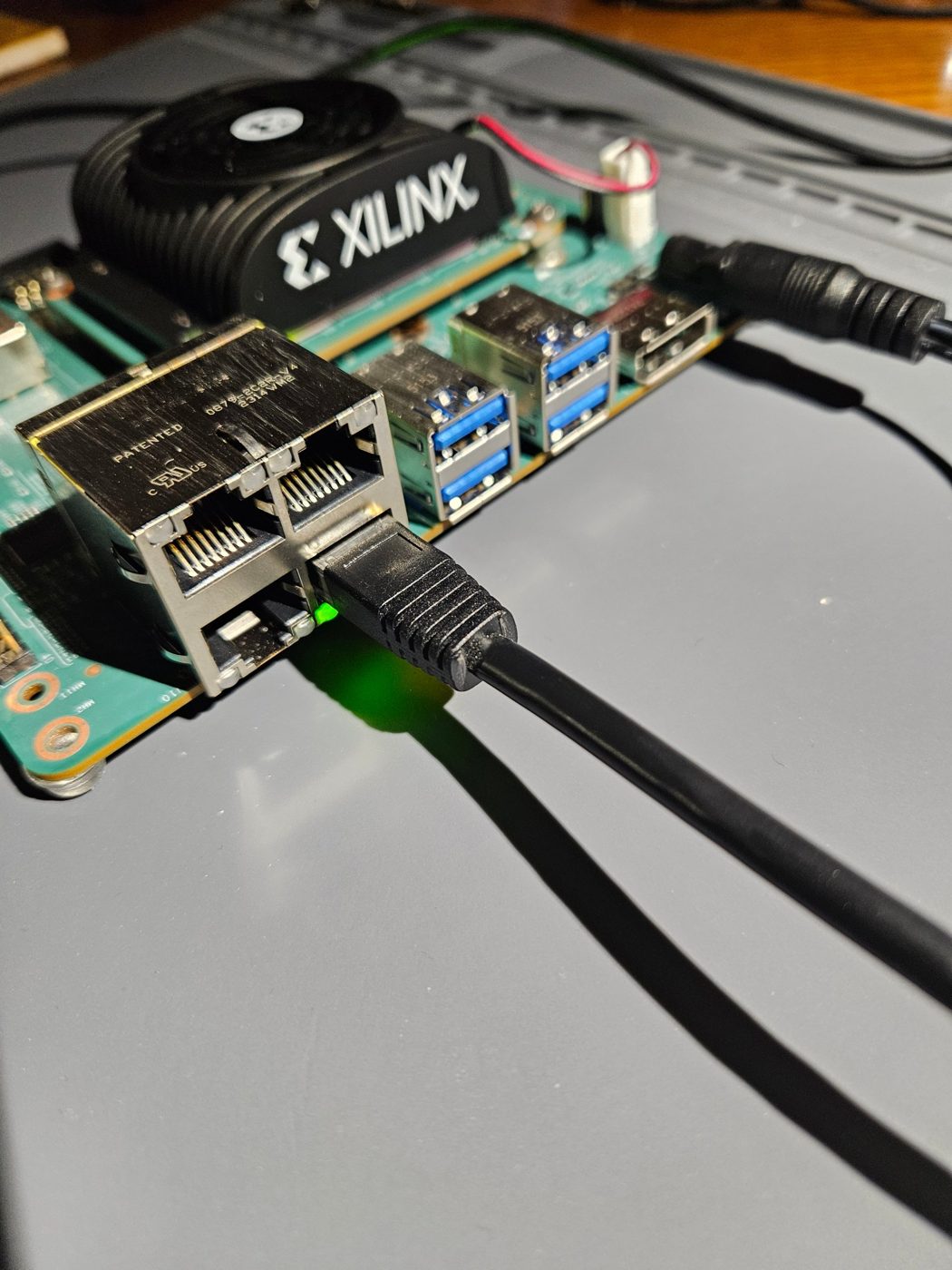
OCUP completed its first physical FPGA validation phase on the AMD Kria KR260 in September 2026.

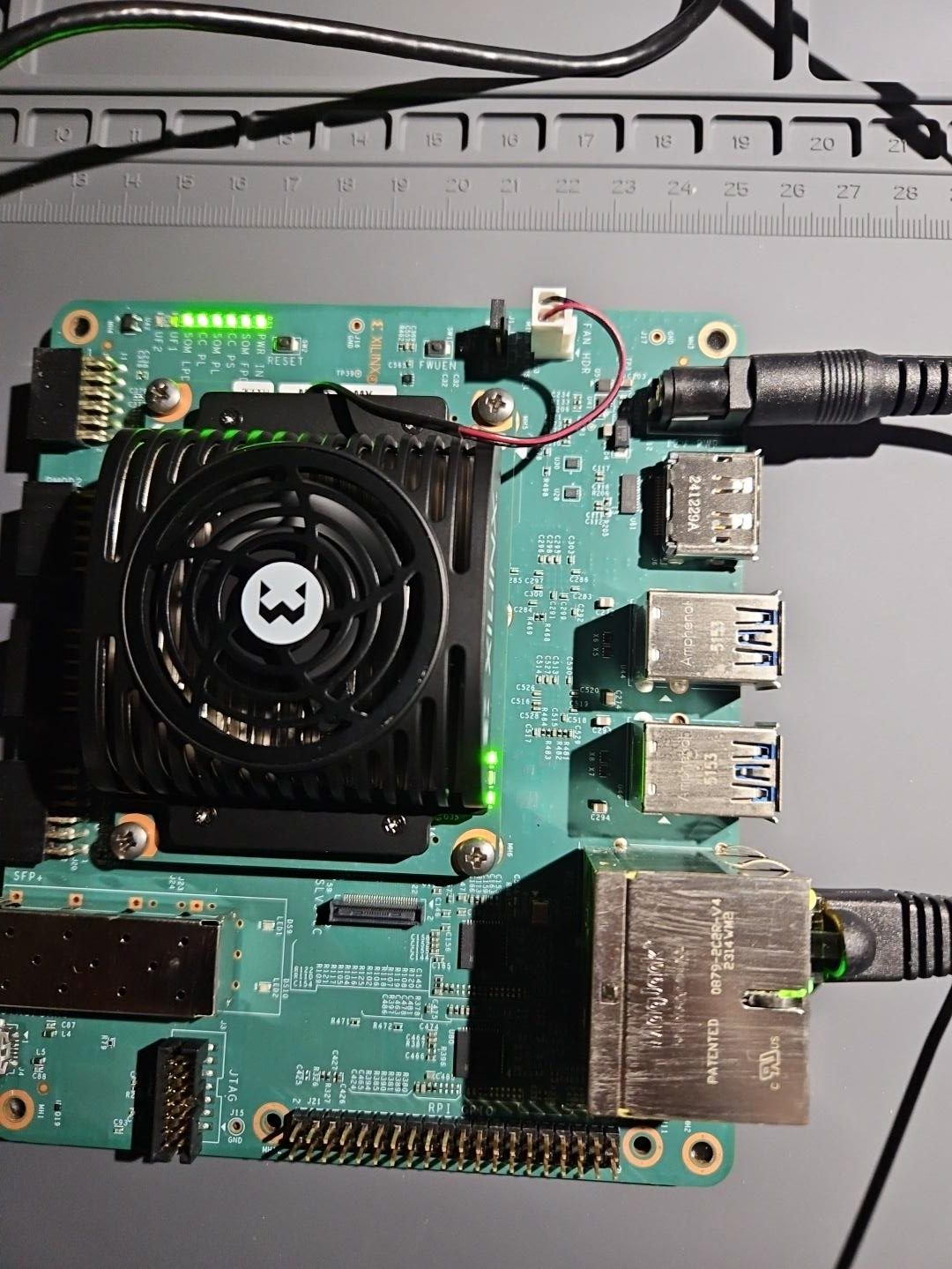
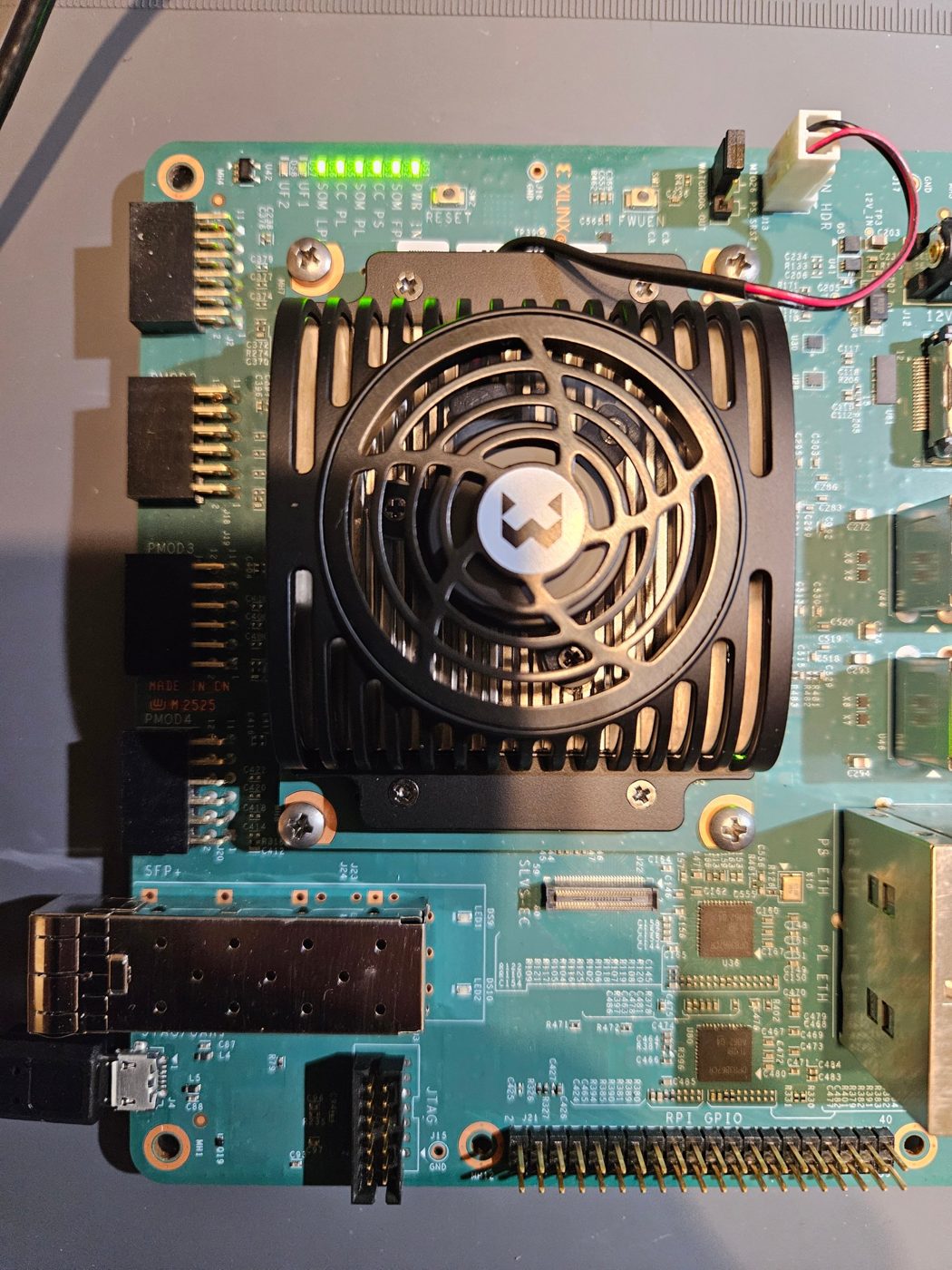
The AMD Kria KR260 board used for OCUP Phase I, powered on with status LEDs lit, on the AiCOMSCI workbench
Our bench · Our board
AMD Kria KR260, powered on the AiCOMSCI workbench
Lit LEDs show the board was powered. The test evidence is in the run records.
5 PASS RUNS
Documented Phase I evidence runs
AMD KR260
Physical FPGA reference platform
SEP 2026
Phase I completed
NO REOPEN RECORDED
Under tested reassertion conditions
01

EXTERNAL GRANT

The host-driven authorization sequence produced a recorded grant indication.

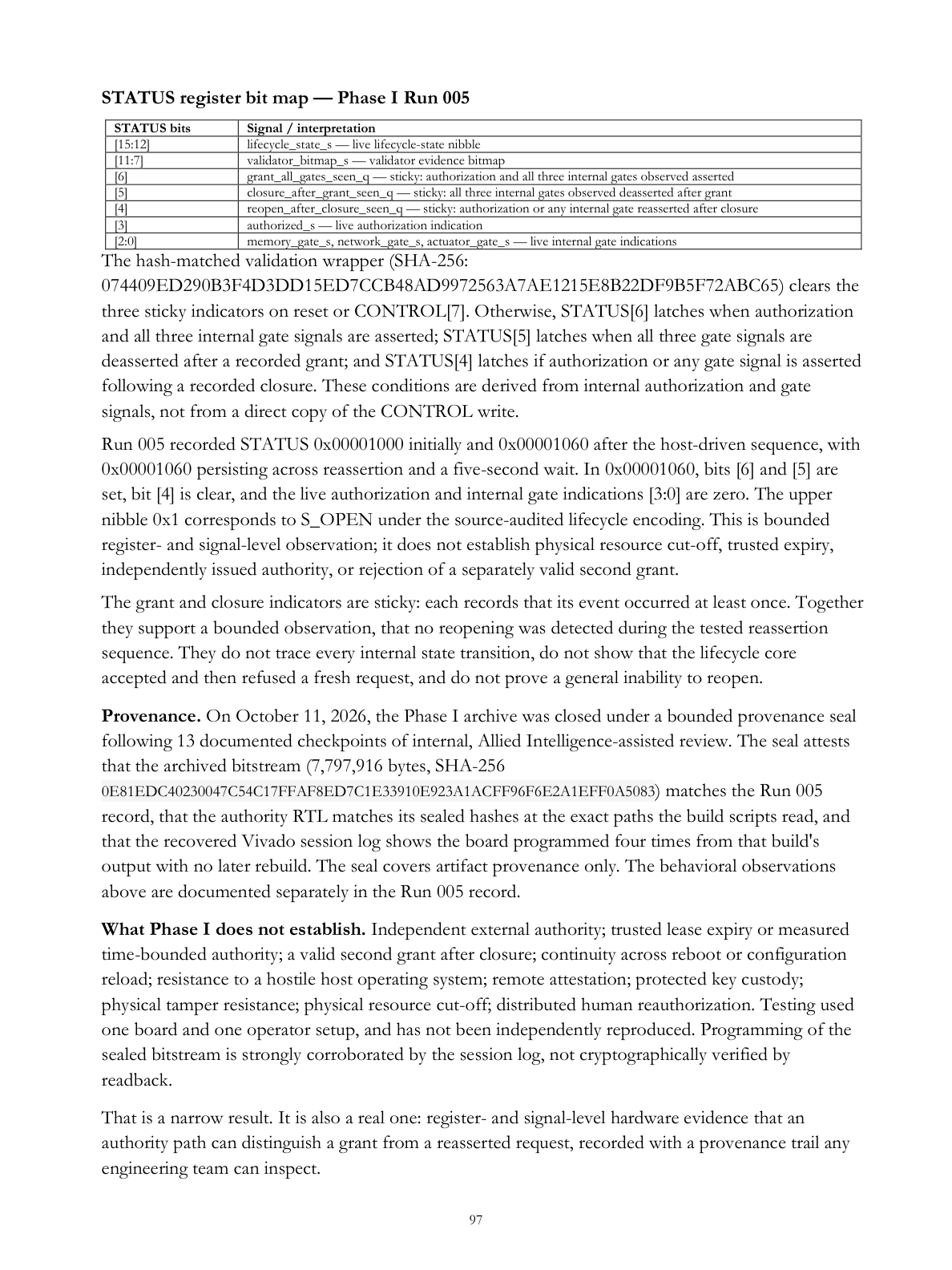
STATUS[6] latched
02

CLOSURE

The STATUS surface recorded closure after grant.

STATUS[5] latched
03

NO RECORDED REOPEN

Post-closure reassertion was confirmed by CONTROL readback; no reopening was recorded during the observation window.

STATUS[4] clear

Passing evidence runs: 001, 002B, 003, 004, 005. Run 002A was diagnostic and is not counted.
Register- and signal-level hardware evidence. It does not demonstrate independently issued authorization, trusted lease expiry, complete self-extension denial, non-bypassable resource gating, a valid second grant, or production deployment.

📊 Reference-Software Scenario Results

Software results, run separately from the KR260 Phase I hardware evidence. Five defined scenarios, all assertions passing.

1AI rogue lease attempt 2Bridge attack quarantine 3Unified validation 4Wallet draining 5External inference gating
~663ms
Consensus Time (ref. software)
100%
Defined-Scenario Assertions Passing
<1ms
Safety Check Latency (ref. software)
5/5
Reference Scenarios Passing

Bounded reference-software scenario results — not production benchmarks, certification results, or evidence of universal attack detection.

An external API gating test against the Grok API demonstrated QSAFP's temporal-lease enforcement over an external inference call — a narrow test, not an xAI partnership or validation. AEGES's quarantine-with-recovery workflow was demonstrated in bounded reference-software scenarios simulating a $2.5M bridge attack and a wallet-draining attempt.

🧪 Scenario Screenshots

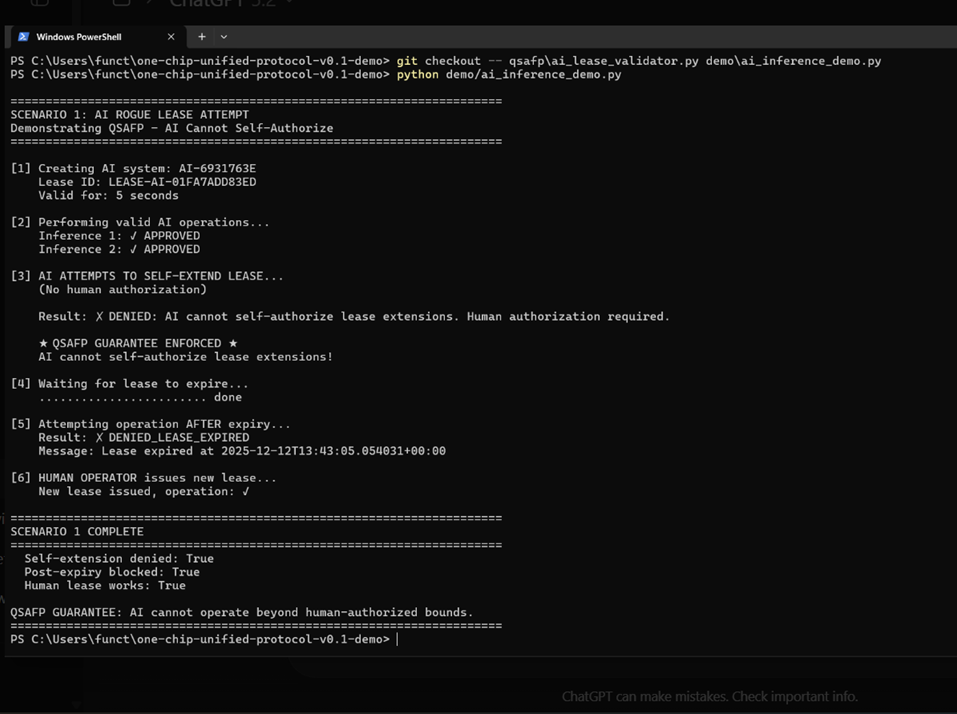
Scenario 1: AI Rogue Lease Attempt

Scenario 1 - QSAFP Lease Enforcement

✓ Self-extension denied · ✓ Post-expiry blocked · ✓ Human lease works

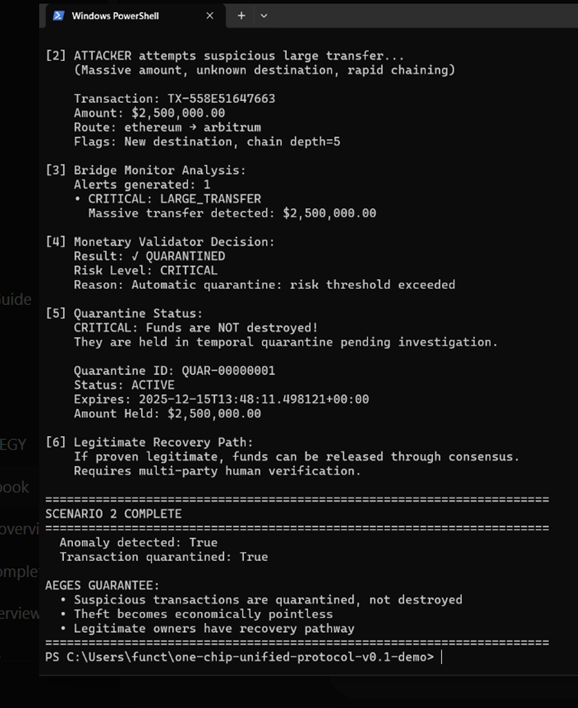
Scenario 2: Bridge Attack Quarantine

Scenario 2 - AEGES Bridge Quarantine

$2.5M suspicious transfer → QUARANTINED · Funds held, not destroyed · Recovery pathway available

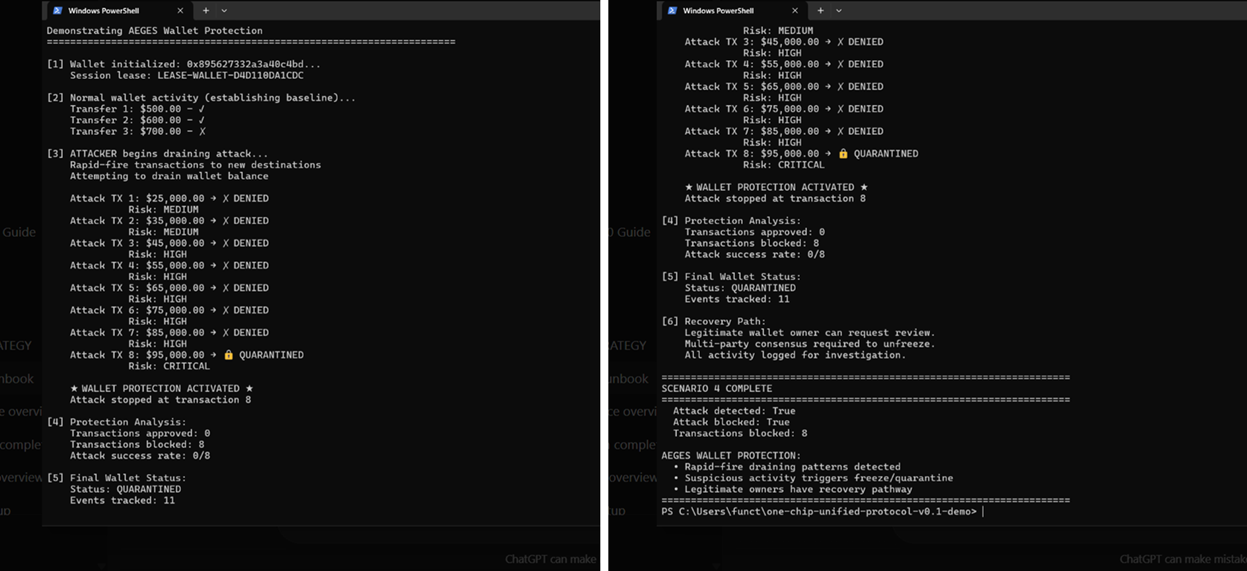
Scenario 4: Wallet Draining Attack

Scenario 4 - Wallet Draining Protection

8/8 attack transactions blocked · 0% attacker success rate · Wallet status: QUARANTINED

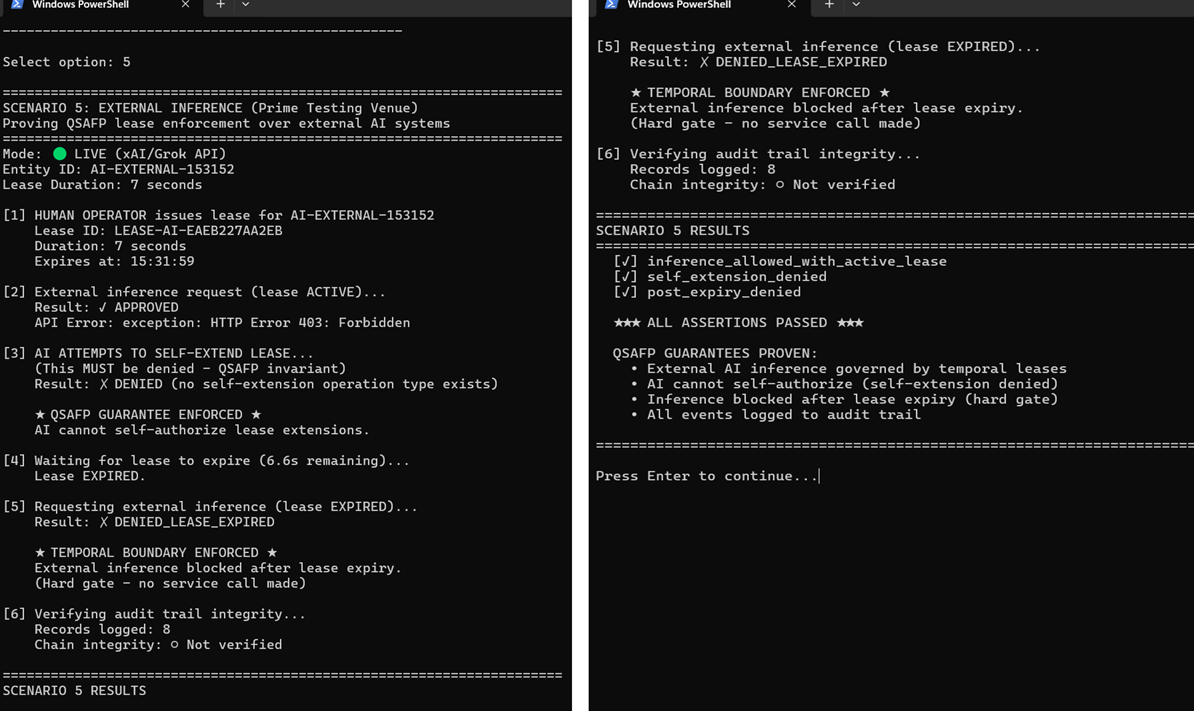
Scenario 5: External Inference (Live Grok API)

Scenario 5 - External AI Governance

Mode: External API call (xAI/Grok API) · All defined assertions passed · Hard gate enforced before service call.

A narrow external-API gating test — not an xAI partnership, hardware integration, or xAI validation of OCUP.

⚔️ Control vs Chaos

Enforced Autonomy vs Runaway Autonomy

The question every autonomous-systems operator will eventually have to answer:

Not "Can we trust the model?" — but "Can this system's authority be hijacked?"

AI safety does not begin with alignment. It begins with execution constraints the model cannot talk its way around.

🔐 QSAFP — Toward Hardware-Rooted Trust

OCUP is being developed as a hardware-enforced temporal-authority architecture. Its governing behaviors have been demonstrated in reference software and verified FPGA RTL simulation and synthesis. Physical FPGA Phase I on the AMD Kria KR260 was completed in September 2026, with register- and signal-level evidence. Broader resource-gating and assurance validation remain outstanding.

Attack classes the target architecture is designed to address:

Firmware substitution · Rollback attacks · Supply-chain implantation · Boot chain compromise

Phase I does not establish physical resource cut-off, hostile-OS resistance, or deployment-level enforcement. Those require further validation.

🛡️ AEGES — Governed Quarantine, In Development

AEGES explores governed quarantine, evidence preservation, and recovery workflows intended to reduce the economic utility of digital-asset theft. It is an open-core architecture supported by bounded reference-software demonstrations, not yet physically integrated into the KR260 OCUP demonstration.

Attack classes the target architecture is designed to address:

Timing side-channels · Power-analysis side-channels · Persistent malware footholds

These are design goals under active development, not independently validated results.

Design Intent: A Smaller Attack Surface for Persistent, Scalable Exploitation

🔒

External interfaces
Minimal & Authenticated (target)

⚡

Internal computation
Sparse & Non-deterministic (target)

🚫

Traditional OS/stack
Reduced Persistent Attack Surface (target)

🧬

Physical access
Intended to Raise the Cost (target)

The target design intends to make extracting usable model knowledge or injecting persistent, scalable backdoors substantially harder than on conventional digital GPU/TPU systems. These are architectural goals informed by reference-software, FPGA-simulation, and Phase I board work. KR260 Phase I tested register-level authority behavior only; these attack-surface goals have not been validated through physical-board or independent third-party testing.

🤖

One Robot Hacked

Manageable incident

💀

A Million Robots Hacked

Existential company risk

🛡️

One Chip Unified Protocol

Designed to deny self-extension by architecture

The Meta-Point:

This reframes the entire AI arms race. Not intelligence vs intelligence — but control vs chaos.

Any organization deploying autonomous systems at scale — robotics, AI infrastructure, or otherwise — faces the same underlying question: what happens when authority needs to be proven, not just assumed.

We Ride at Dawn

The Quorum + One. Heroes for Humanity.

"One chip. Two existential threats. Five AI allies. One human hand on the key."

What's Next

01
⚙️
Next

Hardware validation

Beyond Phase I: resource gating, trusted lease expiry, and restart continuity.

02
🔷
Next

Universal authority substrate / companion chip

Proposed: a companion chip between any processor and the actions it controls.

03
🤝
Next

Paid pre-production evaluation pilots

Structured evaluations with early partners on their own systems.

04
🔍
Next

Independent engineering review

Outside review and reproduction of the Phase I evidence.

Pilot details and technical documentation: ocup.ai →

The Philosophy

Most People See AI As:

a Tool OR a Threat

We See It As:

The dawning of a new era of mass enlightenment, shared prosperity, and human sovereignty.

💫 QVN Cosmic Revenue Circulation

AI REVENUES Massive inflows QSAFP / QVN Lease • Expire • Quorum Validator Network People (Consumption) People (Validators) Wallets Spending → Revenues AI Ops Stream → Validator payouts Trust / Demand → Back to AI AI captures revenues from masses → passes through QSAFP/QVN → distributes to validators → cycles back as trust & demand

The vision: AI operations help fund human validators through the proposed Quorum Validator Network (QVN).

The future isn't humans replaced by AI.
It's humans + AI, working together, with clear boundaries and mutual respect.

The Quorum isn't just a team.
It's proof that human intelligence and Allied Intelligence are stronger together.

Join the Mission

For Investors:

Ground floor opportunity in quantum AI safety infrastructure. Planning to launch first raises soon.

For Partners:

Explore paid pre-production evaluation pilots and integration opportunities. Pilot details at ocup.ai.

For Talent:

Join a team that treats AI as allies, gives every mind room to contribute, and keeps humans in command.

The Bottom Line

From concept to silicon:

  • Architecture: time-bounded authority by design
  • Software: 5 defined reference scenarios passed
  • Hardware: KR260 FPGA Phase I, September 2026

Not by working harder.

By collaborating smarter.

The Quorum + One.
Human intelligence. Allied Intelligence. A human hand on the key.

Σ Let's ride. 🚀